On 1 September 2011, we arrived on this beautiful patch of unceded Djaara Country with a shiny green wheelbarrow strapped to the roof of a low-slung Volvo, a gaggle of young children in the back, and a romantic vision of raising pigs on pasture and selling our meat to a community of people eager to help build a different food system. We wanted to learn for ourselves why more people don’t farm this way, and try to show it is possible and that there are viable alternatives to raising pigs in sheds.
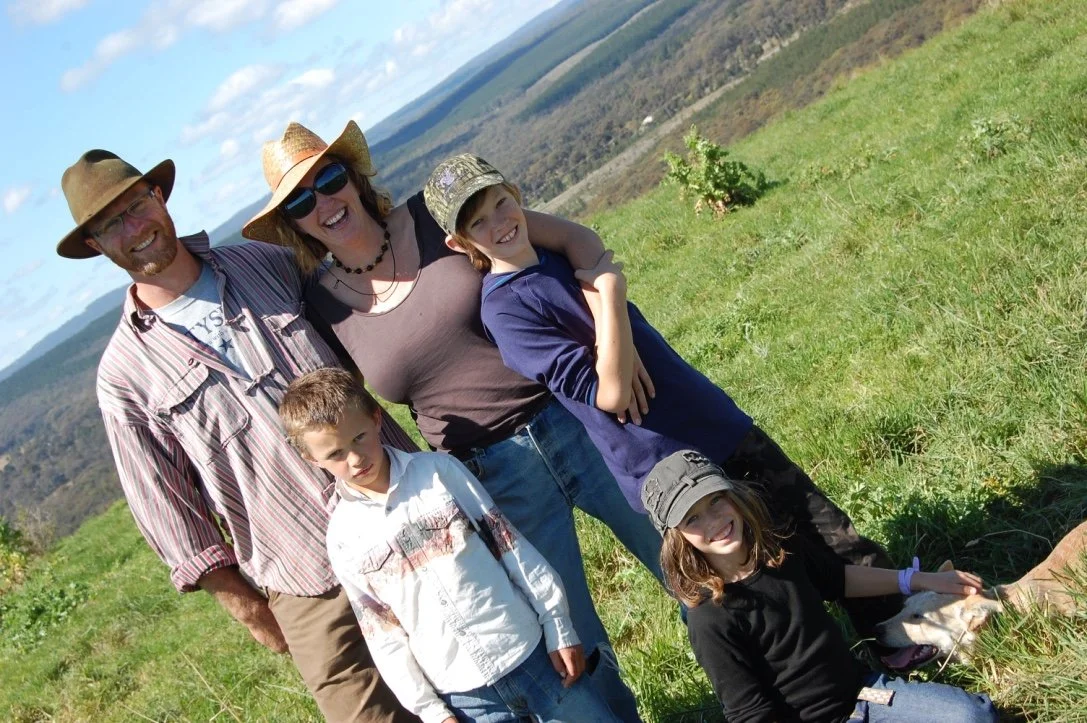
15 years later, we have achieved what now seem like quite modest aims… and so much more. And our understanding of why more people don’t farm this way in Australia and other industrial countries has been hard-won from the paddocks to a PhD.
Fast forward to the end of our sixteenth winter on the farm, and Jonai Farms & Meatsmiths is a well-known beacon for agroecology, with a thriving CSA, a boning room and micro-abattoir, a relational landsharing agreement with proud Ngarrindjeri and Narungga man Josh of Tumpinyeri Growers, and an abundance of offerings to welcome people to the farm for horizontal knowledge exchanges and uncommonly delicious meals, served with a side of food politics. The couple who arrived with a gaggle of children are bald and grey; our kids are all grown, and we are grandparents to soon-to-be three adorable grandbabies.
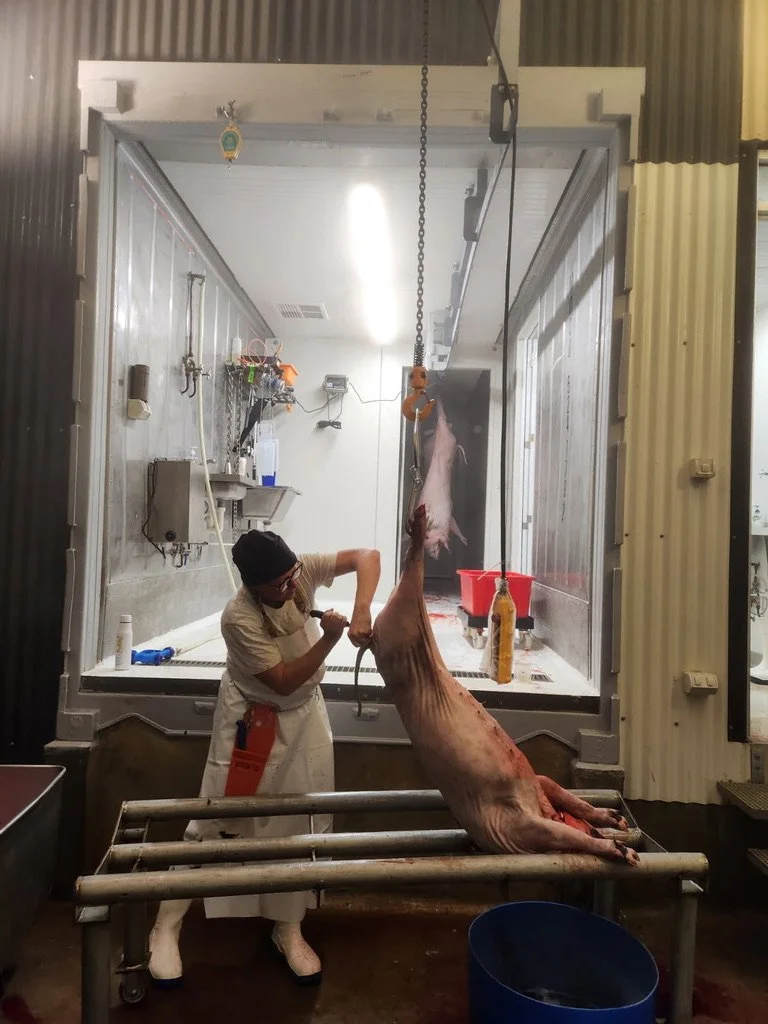
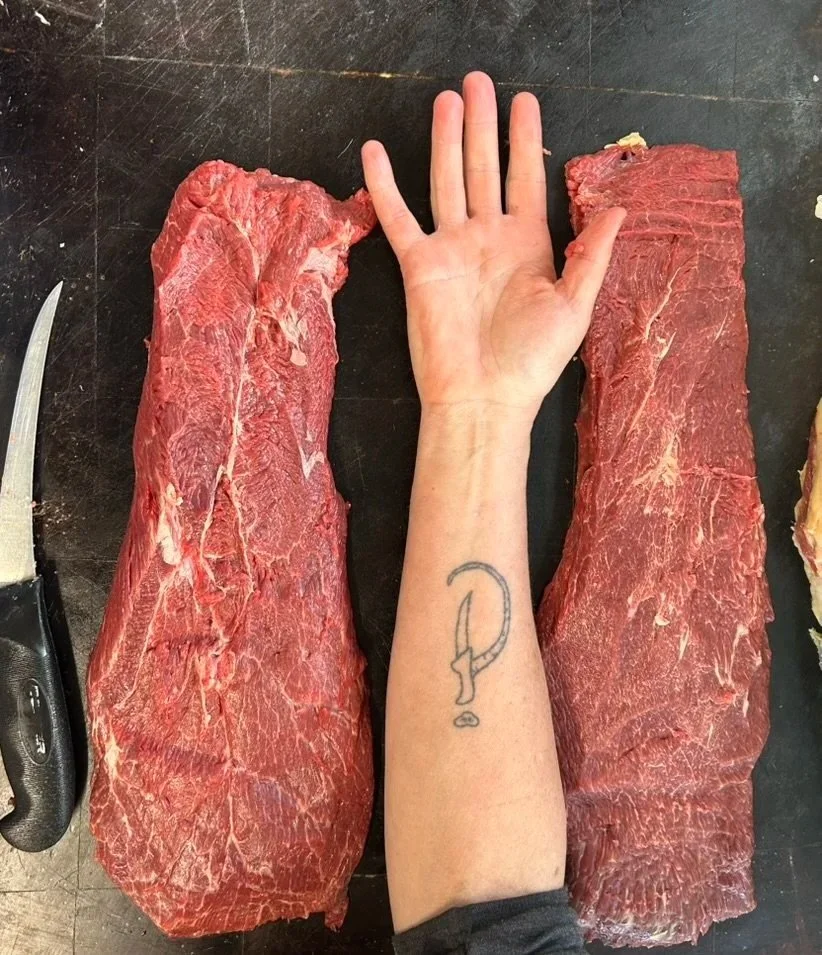
Those following our journey since the beginning – or even just since we commenced the abattoir adventure in earnest in 2022 – will know that the romantic idyll has been punctuated with many exclamation marks, ellipses, and interrobangs (so much so that I had one tattooed on my knife arm by talented intern Tyler in 2019). To an outsider or a pessimist, it probably looks like a bloody lot of hard work, too hard for most. But we Jonai are made of stern and stoic stuff, and you can put it on our gravestones that around these parts, ‘somebody should do something’ means ‘we had better do something!’
So the real story of these fifteen years is not simply that we learned how to farm, butcher, build, organise, and feed people differently; it is that each practical challenge kept pointing us toward a deeper one: how to live relationally in a world organised to make almost everything transactional.
What has been the biggest challenge? To answer that, I’ll walk us through the visible and practical challenges, the institutional ones, and finally the relational challenge underneath them all.
Getting our meat to market? Nope. As soon as we realised we needed a reliable butcher, I became one while Stuart built the boning room. As we saw abattoirs disappearing across the country, we researched, planned, and built an abattoir. As we encountered the common concern about how to make sure we sell everything we produce, we learned from the international community-supported agriculture (CSA) movement. We went CSA in 2014, never really having to ‘sell’ our meat again. There is a 25-year waiting list for Jonai pork and beef, which we regularly divert to other farms in need of members themselves. The hardest part was undeniably the struggle for a permit, and then for Stuart, physically building the abattoir. So through my work with the Agroecology & Food Sovereignty Alliance (AFSA), we got the rules changed. Hence, nobody else in Victoria has to go through the planning pain we did, and we have made our drawings and documents freely available to save people that trouble (or money to consultants) as well.
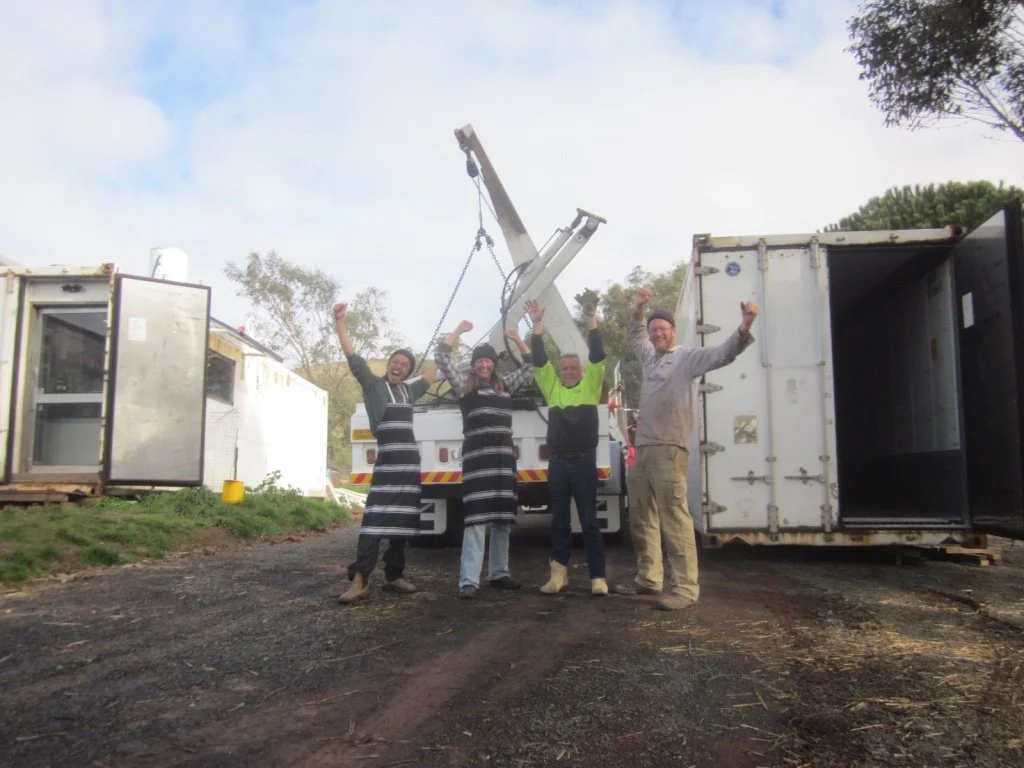
Earning a decent livelihood? Nope. We price our meat at what it costs us to produce and what it's worth to eaters. Wherever we can work out how to pay ourselves to do a job that the commodity system outsources to middlemen, we learn another skill. We repurpose one man’s trash into a plethora of treasures on the farm rather than buying most things new, including diverting thousands of tonnes of surplus yield from the food system into a nutritious diet for the pigs, learning pig nutrition to make this possible. We follow the credo that nothing in nature is wasted; everything is recycled, and as part of nature, it is our custodial role to facilitate the cycle. We've learned that the level of debt the average farmer has to bear is not natural, so we have eschewed that model to build infrastructure and regularly turned to our community instead to lend a helping hand in return for a meal, a raffle, some meat, or a cookbook.
Learning wildly new skills year in and year out? Nope. Having come to farming as a not-long-reformed vegetarian, I am now a butcher and a meat inspector, and both of us are slaughterfolk. Stuart went from being a very handy suburban dad to building a ridiculously impressive cadre of essential infrastructure, from bedrooms, a boning room, commercial kitchen, and a villa in converted containers, to the Belvedere and greenhouse from scrap tin, repurposed windows, and pool fences, to a quarter million dollar rotating composting drum known as Audrey, and finally to a licensed micro-abattoir from mostly reclaimed materials, some he had been saving for just the right thing (hence we call him our resident bricoleur1).
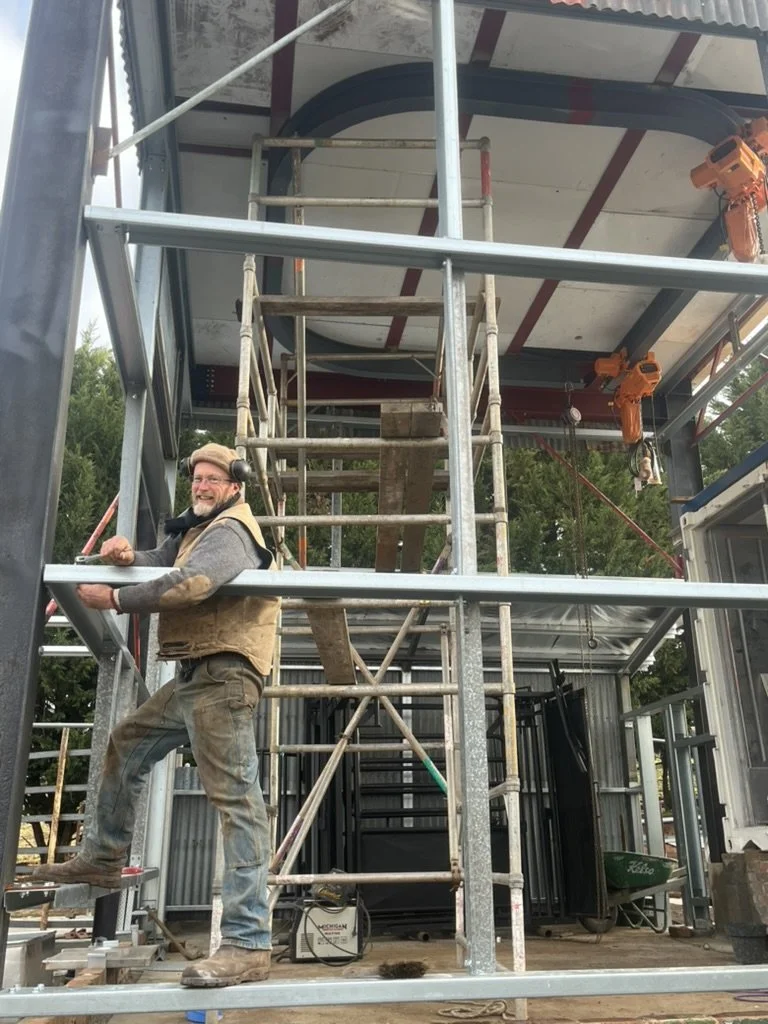
If the first challenges were material questions of production, livelihood, and skill, the next were political and relational: how to build necessary infrastructure while confronting the rules, assumptions, and habits that make small, grounded systems so difficult to sustain.
Dealing with the state? Perhaps. This challenge, universally experienced by peasants the world over, led AFSA to establish a Legal Defence Fund in 2015, publish a legal guide in 2022, and work tirelessly for reforms to remove barriers to smallholders, and led me to write a PhD on the new peasants in Australia and how we are dealing with the state.
Building and being part of a community on and off the farm? A bit. Learning to live more relationally and less transactionally is a journey we’ve been on since before we started farming, but it was a slow burn in the suburbs in our wage-slave jobs (I loved mine, don’t get me wrong, though Stuart cannot say the same). Like so many others, we came wanting to be part of a community of like-minded people looking to savour the world while saving it2, and perhaps the biggest challenge of all has been just this, and also the most rewarding. We have had hundreds of interns, meat grrls and non-grrls, staff, land sharers, and short-term guests through the farm, teaching us an enormous amount about co-living, co-designing, co-working, and collectively trying to build an anti-colonial, anti-capitalist system within a stubbornly colonial, capitalist and patriarchal world. We have built wonderful relations with farmers, chefs, restaurateurs, suppliers, and on-farm denizens who have shared the vision for food sovereignty and agroecology, for living in mutual obligation to each other and the Land. And we have learned that some people appear unable to unlearn the transactional nature of neoliberal society, despite themselves.
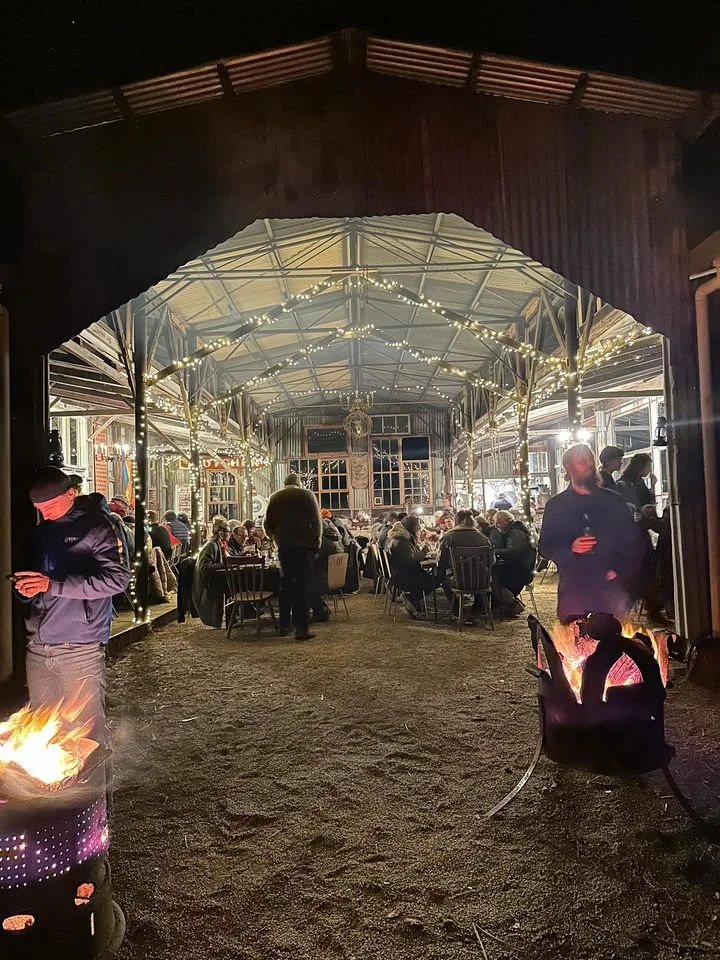
We ourselves have had to unlearn so much of our own internalised sense of entitlement that comes from privilege, and learn to share on more equal terms, to give up some of our privileges so that others can have more. It is not enough to ‘live simply so that others may simply live ’; we must go further, and as Mandela urged: ‘For to be free is not merely to cast off one’s chains, but to live in a way that respects and enhances the freedom of others.’ My work in the global food sovereignty movement has taught me the most about the last part of that sentiment: that none of us is free until all of us are free, and that we all share a responsibility to work for everyone’s freedom, not only our own. Put another way, as Veracini says, I’m not an ally, I’m a co-belligerent.
That practical work has increasingly needed a deeper ethical and intellectual frame, because building a different food system is not only a technical project but also a relational one. We have learned the most from Indigenous Peoples’ ways of thinking and being in the world, through reading, listening, and watching the generous offerings they have produced for this purpose. I want to share a paraphrase of part of my thesis to illustrate some of these learnings.
Indigenous ways of knowing offer a different way to think about today’s environmental and social crises. Instead of treating humans as separate from, or above, the natural world, First Peoples understand people, land, waters, animals, plants, and ancestors as deeply connected. In what is now called Australia, many First Peoples understand that ‘the land is the Law’, meaning people have responsibilities to care for Country and to live well with all living systems. This way of thinking is based on relationships, responsibility, reciprocity, and obligation. It also creates a strong duty to care for land and everything it supports3. This sense of responsibility also helps explain the extraordinary generosity many First Peoples in Australia have shown to settler descendants and more recent migrants, even while colonisation continues on unceded Aboriginal lands. Kombumerri scholar Mary Graham suggests that Indigenous and settler peoples can move forward through ‘autonomous regard’, an ethical relationship that recognises the violence of dispossession and does not turn away from it. Yunkaporta makes a similar point when he urges audiences: ‘don’t talk about your settler fragility all the time, think about your human becoming’4.
Yunkaporta also writes, ‘this is why we’re here. We look after things on the earth and in the sky, and the places in between.’5 This is not to centre humans, but to situate us in an ecocentric conception of world-ecology, in which each constituent of the human and more-than-human world has a cosmological and practical role to play, where custodianship is ours.
This is a somewhat long-winded way to say that the biggest challenge we have faced is learning to live relationally in a transactional world. Along with so many others across our movement, we are trying to build a system that puts people and planet first, not profits, grounded in reality and in every decision we make on the farm or in a UN plenary each day. Like farmers everywhere, we fight for our autonomy, but it is a collective autonomy, tethered to the well-being of everyone in our community. We have not only fought for infrastructure at Jonai Farms, but we have fought for everyone’s right to food, land, self-determination, and infrastructure, and we will continue to do so until we die in our boots.
It’s not easy, and we have had to learn a lot, and we would not have it any other way.
I wrote back in 2014 that Happiness is Hard Work, ‘that is, working hard makes us really, really happy,’ so I guess we’re consistent. Here’s to the next 15 years of happy hard work!
1 The ‘bricoleur’ is adept at performing a large number of diverse tasks; but, unlike the engineer, he does not subordinate each of them to the availability of raw materials and tools conceived and procured for the purpose of the project. His universe of instruments is closed and the rules of his game are always to make do with ‘whatever is at hand’, that is to say with a set of tools and materials which is always finite and is also heterogeneous because what it contains bears no relation to the current project, or indeed to any particular project, but is the contingent result of all the occasions there have been to renew or enrich the stock or to maintain it with the remains of previous constructions or destructions. The set of the ‘bricoleur’s’ means cannot therefore be defined in terms of a project (which would presuppose besides, that, as in the case of the engineer, there were, at least in theory, as many sets of tools and materials or ‘instrumental sets’, as there are different kinds of projects). It is to be defined only by its potential use or, putting this another way and in the language of the ‘bricoleur’ himself, because the elements are collected or retained on the principle that ‘they may always come in handy’. Such elements are specialized 12 up to a point, sufficiently for the ‘bricoleur’ not to need the equipment and knowledge of all trades and professions, but not enough for each of them to have only one definite and determinate use. They each represent a set of actual and possible relations; they are ‘operators’ but they can be used for any operations of the same type.
2 With thanks to E.B. White (1969), 'Every morning I awake torn between a desire to save the world and an inclination to savor it. This makes it hard to plan the day. But if we forget to savor the world, what possible reason do we have for saving it? In a way, the savoring must come first.'
3 Graham 1999, 2021; Yunkaporta 2020; Martuwarra RiverofLife 2020; Loughrey 2020
4 2020
5 2020: 109